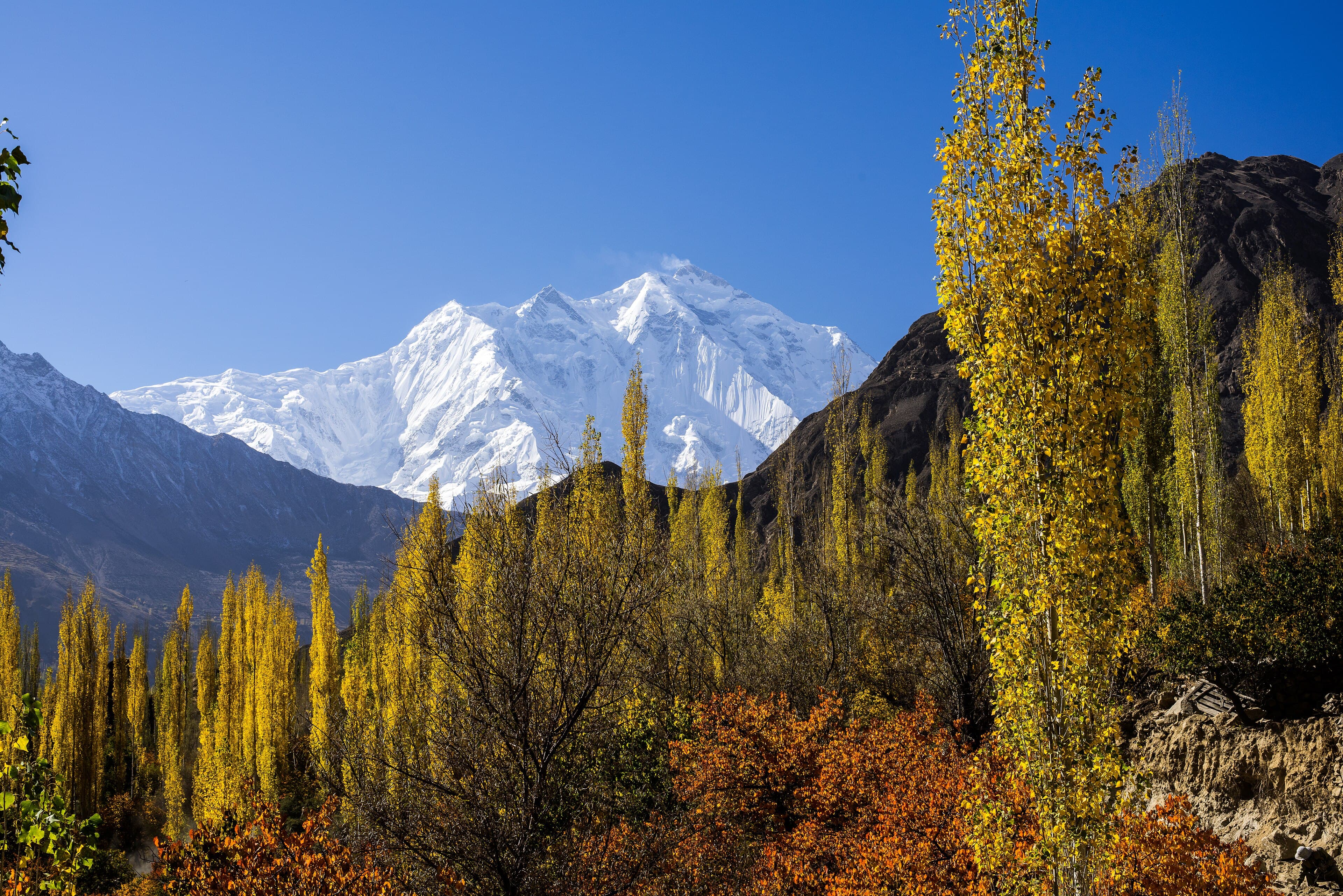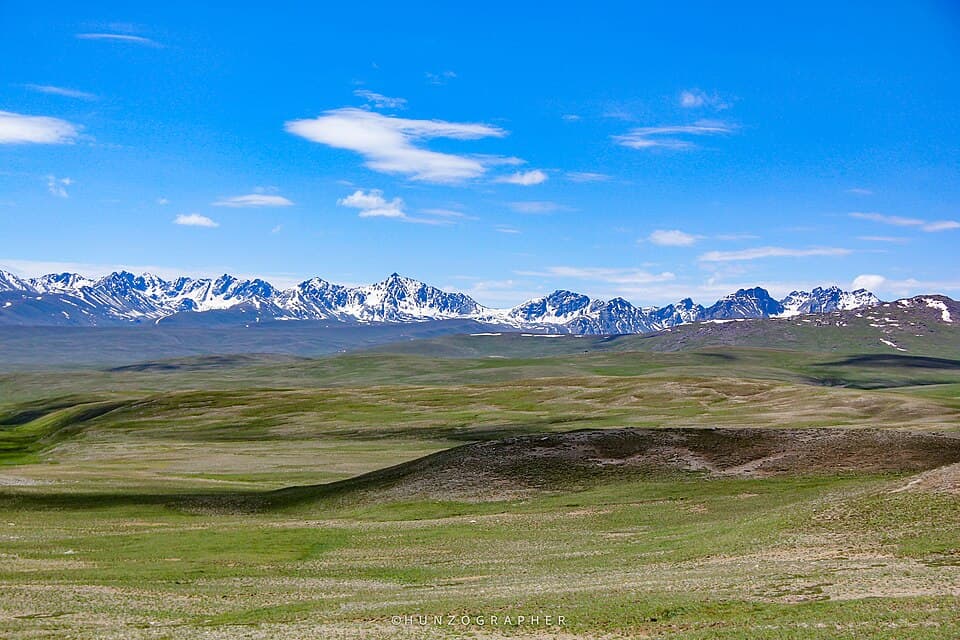
There is a moment on the climb up to Deosai when the world simply opens. The switchbacks fall away, the trees thin to nothing, and ahead of you lies a plateau so vast and so still that the horizon seems to curve. This is the Land of Giants, and for a few short summer months it is one of the most extraordinary places on Earth to stand quietly and watch.
What and where Deosai is
Deosai National Park is a high alpine plateau set between the Skardu and Astore districts of Gilgit-Baltistan, in northern Pakistan. It lies east of Nanga Parbat in the western Himalaya, with the great peaks of the Karakoram not far to the north. Averaging roughly 4,000 metres above sea level, it is one of the highest plateaus in the world.
The name Deosai is often translated as the "Land of Giants", and once you are up there the phrase stops feeling poetic and starts feeling literal. There are no villages, no fields, no permanent residents — only rolling meadow, braided rivers, snowmelt streams and a silence so complete it has a texture. In recognition of its rarity, Deosai sits on Pakistan's tentative list for UNESCO World Heritage status.
For travellers used to the dramatic verticality of the Karakoram Highway, Deosai is a different kind of awe entirely. Where the gorges below are all height and shadow, the plateau is all space and light. It is the sort of landscape that quietly rearranges your sense of scale.
The brown bears and the wildlife
Deosai is best known as a stronghold of the endangered Himalayan brown bear, and that fact deserves a moment of respect. Decades ago these bears were close to vanishing here. Today the plateau is one of conservation's genuine success stories — a place where careful protection has given a remarkable animal room to recover. To share a valley with them, even at a distance, is a privilege.
The bears are far from alone. The meadows are alive with marmots that whistle and bolt for their burrows, ibex picking along the ridgelines, foxes trotting the long horizons, and golden eagles riding the thermals overhead. For photographers and nature lovers, few places reward patience so generously.
A word that matters here: distance. Wildlife on the plateau should always be watched from afar and never approached, fed, baited or pursued for a closer photograph. A long lens and a calm, still presence will always serve you better — and the animals — than getting close. Disturbing a bear is dangerous for you and harmful to a population that has worked hard to come back.
Sheosar Lake and the summer wildflowers
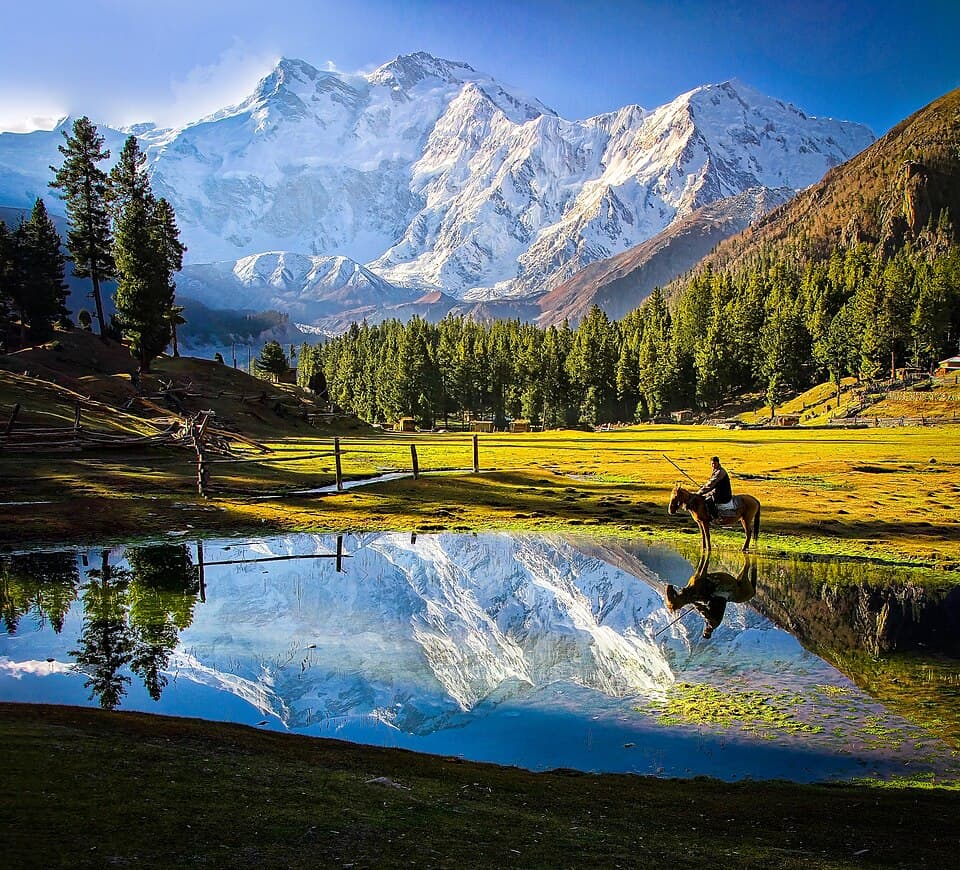
If Deosai has a single signature image, it is Sheosar Lake — a deep, high-altitude lake on the Astore side of the plateau, its surface holding the reflection of distant peaks on a calm morning. Arrive early, before the wind picks up, and the stillness is something you will remember for a long time.
Then there are the flowers. For a brief window in July and August, the plateau bursts into colour as carpets of alpine wildflowers spread across the meadows. It is fleeting and it is glorious, and it is the reason many travellers time their visit to the height of summer. Few landscapes manage to be both this severe and this tender at once.
At a glance
- What: high alpine plateau, averaging ~4,000 m, in Gilgit-Baltistan
- Famous for: Himalayan brown bears, Sheosar Lake, summer wildflowers
- Open: summer only, roughly late June to September; snowbound the rest of the year
- Reached from: the Skardu (Sadpara) side or the Astore (Chilim) side
- Bring: warm layers, sun protection, water, and patience for the wildlife
When it's open
This is the most important practical thing to know: Deosai is a summer-only destination. The plateau is snowbound for most of the year and only becomes accessible once the high passes clear, roughly from late June to September. Outside that window the roads in are simply closed.
Even at the peak of summer, the altitude makes its own weather. Mornings can be cold, afternoons can bring sudden cloud and rain, and nights are genuinely chilly. Dress in proper layers, protect yourself from strong high-altitude sun, and never assume the conditions you set out in will hold. Allowing your body time to acclimatise to the elevation is sensible, particularly if you are coming up quickly from lower ground.
How to get there
Deosai is reached from two sides, and which you choose usually depends on your wider route through Gilgit-Baltistan.
- From Skardu (the Sadpara side): the more common approach for travellers already exploring Skardu and Baltistan. If you are building a Skardu trip, our Skardu and Baltistan travel guide covers the wider region.
- From Astore (the Chilim side): the route that brings you in near Sheosar Lake, often combined with travel through the Astore Valley.
Both sides involve rough, high tracks rather than smooth tarmac, which is exactly why a well-maintained 4x4 and a driver who knows the plateau make such a difference. At Gilgit Adventure Club, our drivers and guides were born in these valleys, our 4x4s are maintained and insured, and our teams are first-aid trained — small reassurances that matter a great deal in big, remote country like this.
Visiting responsibly
Deosai is fragile in ways that are easy to miss. The alpine meadow is thin-skinned, slow to heal and easily scarred, and the wildlife is sensitive to disturbance. Visiting well is not complicated — it is mostly a matter of restraint.
- Keep to existing tracks. Driving or walking off-track tears the meadow and leaves marks that can last for years.
- Take everything out. Carry your litter home with you; nothing belongs on the plateau that did not arrive with the snow.
- Never disturb the bears or any wildlife. Watch from a distance, stay quiet, and let the animals set the terms.
- Tread lightly at the lake. Sheosar's shoreline is delicate; admire it without trampling it.
A leave-no-trace ethic is at the heart of how we guide here. The plateau has survived because people have chosen to protect it, and every visitor gets to be part of that choice.
Our July stargazing camp
There is one more reason Deosai is special, and it only reveals itself after dark. With no towns, no light pollution and that immense open sky, the plateau is one of the finest places in the region to look up.
Each July, Gilgit Adventure Club runs a Stargazing Camp on the Deosai-edge meadows. We bring telescopes, gather around a bonfire as the temperature drops, and watch the stars wheel overhead before waking to dawn breaking pink over the peaks. It is a gentle, unhurried way to experience the plateau — long on wonder, short on rush. You can find dates on our events page. Camps are offered from a per-person rate (indicative — message us for a tailored quote).
Frequently asked questions
Is Deosai safe to visit?
Yes, with the right preparation. The main considerations are altitude, weather and the remoteness of the terrain rather than any particular danger. Travelling with experienced local guides, a sound 4x4 and first-aid-trained teams takes most of the uncertainty out of it.
Will I see a brown bear?
Sightings are never guaranteed — these are wild animals across a very large plateau. With patience, an early start and a good guide who knows the ground, your chances improve. Whatever you see, watch from a distance and never approach.
Do I need to camp, or can I visit for the day?
Both are possible. Many travellers pass through on a longer Skardu or Astore itinerary, while others stay overnight to catch the dawn and the night sky. Our July stargazing camp is built around exactly that overnight experience.
When are the wildflowers at their best?
July and August, when the plateau is in full bloom. This is also the most reliable window for road access and the warmest weather, though "warm" on Deosai is always relative.
A quiet word before you go
Deosai rewards the unhurried. It asks you to slow down, to keep your distance, to leave it as you found it — and in return it gives you space, silence and a sky full of stars that few people ever get to see. If you would like us to help you reach it well, tell us what you are dreaming of through our trip planner and we will send a tailored itinerary within 24 hours.